Showing posts with label politics. Show all posts

Saturday, April 28, 2012

The Race is On

Now that Romney's nomination has become a certainty, we've got about six months ahead of us where the two candidates engage in a race to the bottom.  As the saying goes, the only ones certain to lose this race are the American people.  Liberal friends have recently asked me about my previous statement that I plan to vote for a third party candidate rather than "risk" a Romney presidency.  And while I understand their fear, I feel that keeping Obama for another four years is a disaster in its own right, and a campaign slogan of "The Less Disastrous" candidate doesn't sell me.

There's a new opinion piece that unequivocally puts the blame on the dysfunction in government squarely at the feet of the Republicans.  And as far as it goes, I have no qualms with its assertions -- in Congress, the Republicans are determined to be obstructionist and unreasonable.  But I've seen folks point to that article as a defense of Obama's record, and I think that's ridiculous.  The Obama Administration has the power to do many things.  Many of the things he has done (or failed to do when he could do them) are abominable.

Suppose there was no limit on how many terms a president could serve, and W not only ran but won re-election in 2008.  And suppose that he's running for office again in 2012, and in the past four years, his administration:


Some of these are more important than others, but this record is awful -- I would never consider voting for Bush with that record behind him (and I'm sure I'm forgetting plenty -- these are just the ones that come to mind, and so they're slanted toward more recent events).  Yet these are things that Obama has done (follow the links) -- not Congress or Republicans, but Obama.  That the name and party behind those in/actions is different gives me no reason to reconsider my position.  Nor does the fact that in some instances Republicans have proposed even more radical things.  Even the fact that Obama can both nominate federal judges and serve as a check against such radical proposals is inadequate given how awful he's been without Republican involvement.

Of course I've focused on the bad, and it's only fair to consider the good he's done.  Sadly, many of the good things he's done are qualified successes.  The two unqualified things I give credit for are signing into law the Lily Ledbetter Fair Pay Act, and nominating Justice Sotomayor for the Supreme Court.  The stimulus bill was a lot better than nothing, but it was still too small and poorly designed to get us out of the recession, and its effect was dampened by deficit deals he later made.  Health care reform was a lovely idea, but the law that got enacted is from a template from the very conservative Heritage Foundation, and keeps getting watered down.  Leaving Iraq is a good thing, if you overlook  that the Obama Administration tried to stay longer (ironically, it was bound by an agreement made by Bush that the Iraqis wouldn't budge on).  The Dodd-Frank Act may be an improvement over the status quo (or not, I'm honestly not sure), but what it mostly did was create confusion and give industry a chance to negate its effect.

I have a couple of individuals I'm considering voting for.  But I can safely say that the person I'll decide on isn't the nominee of a major party.

Wednesday, August 12, 2009

Contraindications

From the side of Kathy's pre-natal vitamins:
CONTRAINDICATIONS: This product is contraindicated in patients with a known hypersensitivity to any of the ingredients.
On the one hand, it states something so obvious that no thinking person needs to read it. On the other, some people who believe that the Democrats are proposing to implement death panels are or are going to be pregnant.

Sunday, July 12, 2009

Obama So Far

I said a year ago that my support for Obama was tepid, and six months into his presidency, sadly I cannot say that I think better of the president than I did the candidate. In fact, I think far worse.

On the plus side, he's not Bush. He has stated that torture is not to be permitted going forward. His judicial nominees are presumably adequate -- Sotomayor for example seems like a competent judge who shouldn't tilt the court any further to the radicalism of Roberts/Scalia and the Federalists. In terms of Middle East policy, actually stating that Israelis should keep to their word and cease settlements is also a positive step, no matter how obvious or incremental it actually is. He promoted and signed the Lily Ledbetter Fair Pay Act, undoing a mischievous ruling by the Supreme Court that interpreted the Equal Pay Act in a way that essentially rendered it useless.

On the minus side, despite his campaign rhetoric to the contrary, he's actually working to expand executive authority -- his administration's pleadings in prisoner abuse cases and warrantless wiretap cases endorse Bush administration arguments and even somewhat expand upon them. I'm still having trouble grasping how anyone could support him on these matters after he argues that not only should his administration be able to hold suspected terrorists indefinitely, but that the government should be allowed to keep individuals it deems dangerous even if they have been acquitted. Further, his statement that he plans to close Guantanamo is being shown to be wholly symbolic given his interest in maintaining the ability to create a similar prison in Bagram and who knows where else. I'm almost as disturbed by the relative silence of Democrats in criticizing these positions as I am by the positions themselves.

He's also continued the Bush administration's policies for Wall Street, and doing nothing to make Wall Street accountable for the economic implosion and almost nothing to move forward reforms that might prevent similar implosions in the future.

Meanwhile, Obama's insistence on bipartisanship resulted in a mediocre and inadequate stimulus package, and still yielded only a handful of Republican votes. This mentality is also hurting the likelihood of meaningful health care reform, and jeopardizes efforts at significant climate change legislation. For better or worse, the Republicans have decided to act as the party of No, and unless they want to come to the table with a position that allows for bipartisanship (e.g., both sides possess a common goal but disagree on the means to an end), Obama and the Democrats are much better off doing the right thing. Doing less than that results in bad or failed policy for which Republicans can gleefully point to their votes against.

Obama may yet redeem himself and his presidency, but if the presidential vote were tomorrow, I would unquestionably vote for a third-party candidate.

Friday, December 12, 2008

Quote of the Day

"If we don't do this, we will be known as the party of Herbert Hoover forever."-- Dick Cheney, as part of his failed effort to convince Senate Republicans to vote for the bailout package for the auto industry.

Monday, December 01, 2008

At Least Someone Thinks I'm Funny

A couple of weeks ago, firedoglake had a contest to come up with an appropriate title for George Bush's autobiography. I tossed out several suggestions (comments # 89, 244, & 269), and got a good laugh at many of the other entries.

This evening I was going through my Google Reader backlog from the holidays, and came across the announcement of winners -- I was surprised and delighted to see that I won. I guess anything's possible, but I'm betting that W won't be using the winning entry, "You Can Fool Enough of the People Some of the Time."

Wednesday, November 05, 2008

Wow!

Just, wow. I'm a white male, and this isn't supposed to be my victory. I'm a liberal, and despite the McCain campaign's attempt to label Obama as a socialist, he's a centrist, not a progressive. But somehow his election mattered to me anyhow.

With Bush so unpopular and the economy so bad, given Obama's once-in-a-generation oratorical skill, and the most organized campaign I've ever witnessed, it should have been a walkover. But despite such advantages, and while the outcome seemed inevitable as poll after poll put Obama squarely ahead of McCain, it still was remarkably close. The anxiety over the possibility of a stolen election has faded to dust, and I am so amazingly relieved. And I find myself so incredibly moved by this outcome.

We will soon have a sane president again, after eight years of insanity.

Saturday, September 27, 2008

Neology

I forwarded this nonsensical response by Governor Palin earlier this week.


Note that she gave awful responses to other questions posed by Couric, but while those answers generally demonstrated facile understanding of various issues (indeed, apparently Henry Kissinger is beyond naive on how to engage Iran), the clip I've provided is truly babble, a cacophony of spoon-fed Republican domestic talking points all thrown together in a mishmash.

Later, it dawned on me that her response made about as much sense as it would have if she had given it completely backwards. And it was then that I realized that we needed a new word for such a presentation -- Palindrone.

Wednesday, September 17, 2008

I'm a Constitution Voter

So many political things I could say (and so many posts I've started to write but never finished, let alone posted), but here I just want to say that I've signed up on the ACLU's "I'm a Constitution Voter" page (and added a link on my sidebar). It isn't directly election-related, but I think it's important to help send a message to whoever is elected in November that many people find the Bush administration's disregard for the constitution, as well as Congress' unwillingness to confront the administration on this matter, unacceptable.

Monday, September 01, 2008

I Don't Believe in God

...but if I did, I'd have to feel comforted by the fact that after fundamentalist Christians had prayed for "rain of biblical proportions" to spoil Barack Obama's acceptance speech at the DNC, Hurricane Gustav has wreaked havoc on the RNC.*

* - By no means do I wish to suggest that I'm happy about Hurricane Gustav or the damage it's caused, but that doesn't mean I don't appreciate irony.

Wednesday, July 16, 2008

In the Wake of the FISA Rollover


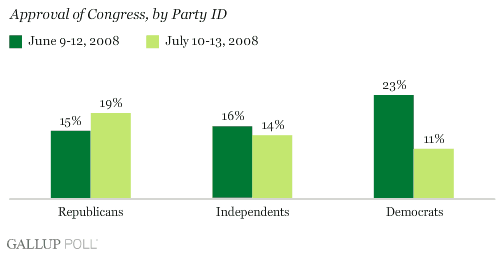
Is it really any wonder that Congress is polling at its lowest levels ever, with Democrats rating it lower than Republicans despite both the House and Senate being in the control of the Democrats?

Friday, June 27, 2008

From the League of You Can't Make This Stuff Up

Apologies for another political post so soon after the last one, but after that downer, I needed a laugh:

Just this week, a group of Republican senators re-introduced the Federal Marriage Amendment to the Constitution, which, as we know, would ban gay marriage.

And once again, the language is pretty straightforward:

Section 1. This article may be cited as the `Marriage Protection Amendment’.

Section 2. Marriage in the United States shall consist only of the union of a man and a woman. Neither this Constitution, nor the constitution of any State, shall be construed to require that marriage or the legal incidents thereof be conferred upon any union other than the union of a man and a woman.’.

This isn’t especially surprising. Republicans are looking at the political landscape, and they’re feeling awfully discouraged. The polls look bad, the base looks depressed, and fundraising looks iffy. Rallying the far-right troops with an anti-gay amendment to the Constitution — even though it has no chance at even getting so much as a hearing — might be helpful to the conservative movement.

But the funny part is looking over the list of the 10 original sponsors. Most of the names are predictable — Brownback and Inhofe, for example — but there are two others whose names stand out: Sens. David Vitter (R-La.) and Larry Craig (R-Idaho).

Yes, two of the principal sponsors of a constitutional amendment to “protect” marriage include one far-right Republican who hired prostitutes and another far-right Republican who was arrested for soliciting gay sex an airport men’s room.

As my friend Kyle put it, these two are “not exactly the poster boys of the family values crowd or particularly upstanding examples of the supposed sanctity of the ‘union of a man and a woman.”‘

Source.

Wednesday, June 25, 2008

Why, Obama? It Matters!

Upon returning home on Sunday, I discovered that not only had the wretched FISA bill passed the House, but that Obama has come out in support of it.* I came up with four possible reasons why Obama might have done this:
1. With the nomination secured, he figures that he has to "move to the center."
2. He felt the bill's passage is inevitable, and decided that it would look bad to support a loser.
3. His earlier rhetoric wasn't genuine, but merely a way to win support.
4. He expects to be president, so isn't concerned about abuse of executive power.

Needless to say, I find none of these reasons, alone or in combination, a sufficient basis for his change of heart. I'm not going to name all the things wrong with the bill (it goes far beyond the telecom immunity feature); rather, I encourage people to read Senator Feingold's summary analysis of the bill's shortcomings, as well as Glenn Greenwald's excellent series of posts on the subject. Suffice it to say that overnight my support of Obama went from solid to tepid, and that any earlier interest in contributing to his campaign has evaporated. I know that no politician is perfect, and also that Obama is not and never has been a progressive, no matter the efforts underway to label him as ultra liberal, so maybe I shouldn't be so disappointed. All the same, one of the principal reasons I favored Obama over Clinton was a belief that he "gets" the importance of civil liberties, to me one of the most important issues there is, and the protection of which should, and occasionally does, cross political lines. Now I find that he doesn't get it, and doesn't see that this is one of the principles and positions over which one should not cave.

Given that I live in DC, it's easy to vote my conscience in the general election, because no matter what I do, the Democrat will garner over 80% of the vote -- I need not fear that my vote will enable "the greater of two evils" to claim the White House. Given that I have that luxury, I need to re-examine whether I want to vote for him, because his position here suggests that he isn't the candidate I thought he was.

[Update]Unlike Obama, Senator Dodd "gets it."
--
* - I consider his statement that he will try to get telecom immunity taken from the bill to be worthless -- he has stated that he supports the bill (and presumably will vote for it), not that he won't support it unless telecom immunity is removed.

Wednesday, June 18, 2008

Things That Got Me Thinking in the Last 24 Hours

In other news, on Sunday I started with a stomach bug, and for the next 60 hours I hardly ate (I'm still eating much less than I was pre-bug, and am only just now starting to add dairy back to my diet (beer yet to be reintroduced)). On Monday evening the cold Kathy and Emelia were suffering started hitting me. Yesterday I felt miserable but went into work largely for an important meeting with an outside group (said meeting lasted all of 15 minutes and didn't cover anything new). As of today, Kathy and Emelia seem to be recovered, and while I'm feeling mostly better, I lost my voice this afternoon. We head to Minnesota tomorrow to attend Kathy's college reunion, and I'm keeping my fingers crossed that it'll be smooth sailing healthwise by then.

Sunday, April 20, 2008

Another Depressing Facet of the Iraq War

I don't watch TV much these days, but I wouldn't be surprised if the big story in today's New York Times doesn't generate much attention in any of the television news programs. I didn't see any mention of it on CNN.com's front page (but there is of a car used in the latest James Bond movie plunging into a lake), or cbsnews.com's (though a bully apparently tried to poison a student with peanuts), or abcnews.com (an Indiana woman turned 115), or foxnews.com (same bullying piece as CBS). Only msnbc.com's site acknowledges it. Given that the article can be read as completely undermining the various networks' (and many other news source's) coverage of the Iraq War, I suppose it's no surprise. At the same time, it's appalling that they fail to acknowledge the report, or what it means.

Thus, in case you missed it, this article reports on the fact that the "military experts," those retired officers who have been providing the bulk of the analysis of the Iraq War, from the lead up to present day, were routinely briefed and prepped by the Pentagon in order to get out the message that the Pentagon wanted to express. Moreover, most of them work for defense contractors and thus have an interest in currying favor from the Pentagon. The article provides numerous examples where an officer believed the Pentagon's position didn't hold up, but where he nevertheless elected not to reveal his doubts or concerns when given a public opportunity to do so. I could quote the article extensively, but I recommend that you read the whole damning thing, even though it's rather long.

I wish I could say that I was surprised to learn this, but really I wasn't. It greatly saddens me that the invasion and subsequent disaster in Iraq could have been avoided if these officers had spoken up when they had concerns, that they had no qualms about allowing themselves to serve the Pentagon rather than the American public, and that the news media that plays a role in forming public opinion failed to address the conflicts of interest before giving these retired officers a platform to shape public opinion. What could sadden me even more is if the networks' failure to acknowledge what has happened, or their role in it, leads to future such happenings. For this reason, I encourage everyone to get the word out to those who get their news from the very cause of the problem.

Wednesday, February 06, 2008

My Vote

Despite the fact that the United States started with the "self-evident" premise that "all men are created equal," it took 94 years after its founding before blacks were able to vote, and it took another 50 years for women to be given that same basic right. Another 88 years have passed, and we're still waiting for the first non-white, non-Christian, or non-male to be elected president. Amazingly enough, either of the two remaining contenders on the Democratic side could end the white Christian male reign, and in the abstract I'm delighted by that prospect. But elections aren't in the abstract, they're about the positions, qualifications, and character of the individuals running for office. And how one casts his or her vote usually is influenced by other, non-substantive factors, such as perceived electability and how the media characterizes and portrays the candidates.

I try not to consider these last two factors, but in order to do that, I have to recognize the possible influence they play. In national polls, Obama is much more favorably viewed than Clinton is. There are probably a number of reasons for this, but the three non-substantive reasons I can think of offhand are: (1) charisma, (2) familiarity, and (3) sexism. Obama is young and handsome, and a dynamic speaker -- he has charisma that none of the other candidates possesses. As for familiarity, the old saw is that it breeds contempt, and given the "dynastic" concerns with respect to the Bushes and Clintons, that certainly seems true here. And then there's the media, which seems to take delight in holding Clinton to a standard that none of the other candidates are held to, a standard that strikes me as sexism pure and simple. Quite frankly, it disgusts me. It dates back to at least the Lewinsky scandal, and probably before -- she was condemned for having been cheated on and staying with Bill, but she would have been condemned at least as much for leaving Bill. With a media that takes delight in focusing on non-substantive rather than substantive matters among the candidates (quick -- tell me three things about John Edwards' aborted candidacy that don't involve a $400 haircut), she is criticized no matter what she does.*

Ok then -- assuming I can get past these non-substantive factors, where am I on the substantive ones?

On many of the issues I care about, such as choice, I think there's basically no difference between Clinton and Obama. With respect to the economy, their initiatives, while similar, show some differences, but to be honest I don't feel I'm qualified to say which one offers the superior package. On healthcare, I think Clinton has the more carefully considered approach, and Obama is looking somewhat shabby (but where she's going to come up with the money to pay for her superior proposal is another matter entirely). Otherwise, on pretty much every issue where they have a substantive difference, Obama comes out ahead. Katherine supports Obama based on her knowledge of the issues of Iraq, foreign policy generally, immigration, civil liberties, criminal justice, and human rights. Given the extremes that the Bush Administration has gone to on most of these issues, it seems critical to me that we have in office the person most likely to undo as much of those extremes as possible. hilzoy, probably the blogger I most respect, makes numerous additional points in Obama's favor.

As for qualifications, some argue that Obama is inexperienced, but on closer examination, that doesn't seem to hold up. Much has been made of Obama's desire to be bipartisan, which some have taken to mean that Obama will compromise on issues that he shouldn't just for the sake of bipartisanship.** But if one actually looks at his track record, as hilzoy has done, one can reasonably conclude that "Obama tries to find people, both Democrats and Republicans, who actually care about a particular issue enough to try to get the policy right, and then he works with them. This does not involve compromising on principle. It does, however, involve preferring getting legislation passed to having a spectacular battle." That strikes me as leadership -- he's been able to get good things done.

Lastly, there's the hard-to-quantify character issue, which I think also favors Obama.^ With respect to the campaigns, it's nearly impossible in a constantly under-the-microscope environment to remain completely clean among the inevitable mudslinging, and Obama isn't spotless in this regard. At the same time, Clinton seems to have done more mudslinging (largely through intermediaries, including Bill). Of greater concern to me is her efforts to change the rules of the election in midstream -- by arguing that the Florida and Michigan delegates should count only after it was clear that they broke in her favor (rather than challenge the DNC's bad decision to exclude them at the time the decision was made), and to sue days before the Nevada caucus over the rules that some of her campaign team helped create in last-minute changes to the rules established in Nevada. Beyond the campaign, however, is the sense that she formulates her positions not necessarily on what she believes is the right answer, but what she considers the most politically supportable one. Perhaps not surprisingly, I feel this way most about the way her position on Iraq has "e vol ved."

For these reasons, I've decided to vote for Obama this Tuesday. That being said, I still favor Clinton over any of the Republican offerings. If you watch the January 31 debate that had only the two of them, you can see substantive discussions and debate, something generally absent from the "I'm more conservative than you are, you hippie Liberal (but I still represent change from Bush)" Republican slugfests.

--
* -- That being said, sometimes charges of sexism go too far, and are unwarranted. New York NOW's condemnation of Ted Kennedy's support of Obama is one example. Another is the indignation some folks feel when Hillary is asked about Bill Clinton's role -- if she considers him an asset on the campaign trail based on his experience (and fails to repudiate his remarks that generate controversy), it's fair game to ask whether she considers him an asset in the White House based on his experience.
** -- T
ruthfully, I'm much more concerned that Clinton, rather than Obama, will seek bipartisanship at the expense of progressive principles, something her husband was frequently accused of. Case in point.
^ -- Then again, maybe not.

Friday, February 01, 2008

Afghani Sentenced to Death

What was Sayed Pervez Kambaksh's crime? He shared a report he downloaded from the Internet which contended that "Muslim fundamentalists who claimed the Koran justified the oppression of women had misrepresented the views of the prophet Mohamed."

I'm not about to suggest that things aren't any better under Karzai's rule than they were under the Taliban, but on this matter, there doesn't seem to be much difference. Karzai can still pardon Kambaksh, but given that a key ally of his proposed a ruling in Parliament that condemned Kambaksh, I don't expect it to happen without significant international pressure. As the article notes, the UK is attempting to do just that.

Unfortunately, I haven't heard anything about the U.S. doing anything on Kambaksh's behalf, and while I'd like to believe the government is doing something, I'm not optimistic. For Bush to acknowledge that there's a problem with freedom in Afghanistan would serve as too sharp a contrast with what he said in his State of the Union address:
In Afghanistan, America, our 25 NATO allies, and 15 partner nations are helping the Afghan people defend their freedom and rebuild their country. Thanks to the courage of these military and civilian personnel, a nation that was once a safe haven for al Qaeda is now a young democracy where boys and girls are going to school, new roads and hospitals are being built, and people are looking to the future with new hope.
With that context, I'm not optimistic about Kambaksh's fate.

Monday, September 24, 2007

An Unreasonable Application of a Reasonable Idea

Raise your hand if you know how the electoral college works. If you do and live in the United States, you're part of a small minority. For those who don't, here's a very brief civics lesson.

The general idea is that citizens of each state vote for representatives (electors) to a body (the electoral college) that selects the president, and the number of representatives each state gets for the electoral college is weighted, based on the number of senators plus representatives to Congress. As for how the representatives for a particular state votes, that's usually on a winner-take-all basis. In other words, if a candidate has more votes than the runner up in a state, all the state's representatives to the Electoral College vote for the winner. While this process usually results in the popular vote getter for the whole country winning the election, it doesn't always. The 2000 election is a good example of that. Because of the winner-take-all approach, in theory someone can win the 11 most populous states by one vote each, get crushed in the remaining 39 states, and still get elected president.

And yet, there is no requirement that a state have all its electors vote for the statewide winner. In 1972, Maine decided to have two of its electors vote for the statewide winner, with the other electors decided based on Congressional district. With Maine presently having four electoral votes, it's possible that Maine can vote 3-1 in the electoral college. In 1992, Nebraska (presently with six electoral votes) adopted what's known as the "Maine Method," and those two states are the only ones that do not follow the winner-take-all approach for their electors. Going back to the 2000 election, if Florida had also done this (and assuming no other state did), then Gore would have been elected president.
[/civics lesson]

It seems so much more reasonable for the electoral votes to be assigned under the Maine Method that it seems a wonder that more states haven't adopted it. Actually, given the politics of getting laws changed, it's no wonder at all. If you've got a largely Democratic state, with its governor and state legislature majority Democrat, and most of its Congressional representatives the same, there's no incentive to change the state laws so that the Democrats lose electors to Republicans. And the same holds in reverse. Thus, generally speaking, about the only way to switch to this approach en masse would be at the federal level, where both Democrats and Republicans have something to both win and lose. I'm not sure, however, that even if there was the impetus, whether the change could be done by statute. If it had to be done by constitutional amendment, it would be much harder, given that it would need to go through all those state legislatures that aren't changing things right now.

The wrinkle to all this is that some Republicans in California are proposing an amendment to the California constitution that would adopt the Maine Method in California. The amendment, which can pass by a simple majority of voters, would bypass the legislature. California has by far the most electors in the country, and in recent years has voted Democrat in the presidential elections, by significant margins. But not all of California is Democrat. In the current Congress, 19 of its 53 seats in Congress are held by Republicans. Under the Maine Method, if only 15 of those districts voted Republican in a presidential election, California would shift from 55-0 to 40-15, i.e., from +55 for the Democrats to +25, a difference of 30. It's far more likely that Republicans would carry even more districts (according to the link above, Bush took 22 districts in 2004, so the "Maine Method" would have moved Kerry's net in the state from 55-0 to 33-22, a difference of 44, and made the count in Ohio irrelevant). As you can imagine, that would make a huge difference in the 538-seat electoral college, given Bush defeated Gore by only five electoral votes in 2000.

The Republican entities promoting the amendment contend that this change would cause candidates to pay more attention to California, but political scientists say it would have the opposite effect. That's because gerrymandering has created so many safe districts in the state that there won't be but a handful of districts in play. They say it would be far better for candidates to focus on states like Florida, with its 27 electoral votes all going to the winner, and a fairly even split of the electorate. But then again, no matter the assertions being made, as the numbers I pointed out above demonstrate, there's little doubt that the point of this amendment is to neutralize a key source of electoral votes for Democrats.

Will California enact the Maine Method? As I noted, in the abstract it seems like a very reasonable idea. The question is whether voters will be able to look past the abstract and recognize the partisan purpose of the proposition. Perhaps some will say that it's the right thing to do on behalf of California, even if other states don't do the same. Regardless, if it passes, it will have major repercussions for presidential elections for years to come.

Thursday, June 07, 2007

Letters for Scooter Libby

When Scooter Libby's sentence was handed down, the judge also made public the letters he had received in response to his invitation for people to comment on the sentencing. I’ve been skimming them, and have been struck by the consistency of what I’ve read. The letters were from (1) professional colleagues and associates; (2) personal friends and acquaintances; and (3) people with no direct ties to Libby.

As near as I can tell, everyone in category 1 & 2 has nothing but glowing things to tell of Libby, and asked the court for leniency. The people in these categories include several famous names (e.g., Kissinger, Rumsfeld, Wolfowitz, and Deborah Tannen (who’s his next door neighbor)), and the support also came from a number of people who stated that they disagreed with him politically. Even though I’m not sympathetic to Libby, I became impressed with Libby by what I learned in some of these letters -- the personal anecdotes describing both the numerous good things he had done and the caring he exhibited in all facets of his life suggest that Libby has been a wonderful person. "His actions were never about what he could get out of it personally. . . they were about how he could help others." Many of the letters expressed shock that he could have done what he was convicted of doing -- "I cannot state strongly enough that Scooter's conviction is completely inconsistent with his character. First, . . . Scooter is extremely honest. I never knew him to lie, exaggerate or bend the truth, NEVER."

On the other side of the ledger, everyone in category 3 (about 10% of the letters) asked the judge to sentence Libby to the maximum (or to deviate upward) based on the seriousness of the crime.

Libby argued that his sentence shouldn't have included jail time. I recognize the argument that even without jail time, Libby will suffer a great deal -- with this conviction, his legal career is at an end. Nevertheless, obstructing justice and perjury are serious crimes. Someone who obstructs justice prevents justice from being carried out, and protects people who should be prosecuted. If the penalty is a fine, then you create an incentive for those who have committed crimes to in essence buy their way out of having to face the consequences of their illegal activities. Without real consequences, there’s little reason to testify truthfully. The investigation here was into the outing of a covert CIA agent, and there's a significant possibility that in addition to the loss of the intelligence network she worked with, people who were part of that network may have been killed as a result. It's probable that we won't ever know the full effects of the outing. Nevertheless, despite the potentially serious consequences, Libby has shown no remorse for his obstruction into this investigation.

Ultimately, I agree with John E. Rogers, a former Assistant United States Attorney, who said in his letter --
I urge you to impose a sentence in this case appropriate to the crimes committed by this defendant, taking into consideration his betrayal of his high position and his country, his superior knowledge as a lawyer and a former partner in a major law firm as to exactly what he was doing, and his continuing unrepentant conduct. Whether he is kind to his dog, a good neighbor, or anything else is, of course, irrelevant to what he did and continues to do.

Tuesday, April 24, 2007

But, But -- Republicans were in Control When It Passed

After reading this letter to the editor, I have to conclude that newspapers don't have any responsibility to protect people from themselves.

Update 4/25/07

Monday, April 23, 2007

Flags at half-mast

Over the weekend as I drove around town, I saw that flags were at half-mast all over town. Since then, I confirmed that President Bush had ordered flags to be flown at half-mast through yesterday in honor of the Virginia Tech dead.

While it's sad that those 32 people died, and while I don't have an objection to their being mourned nationally in such a way, I was struck by the lack of similar recognition given to the American soldiers, many the same age as the students who died in Blacksburg, who are dying every day in Iraq, and to a lesser extent, Afghanistan. The Blacksburg 32 get a week of such recognition, while the 3,000+ who have died over the past five years in the service of their country are recognized as part of a day of national mourning (Memorial Day) along with all other fallen soldiers from all other wars.

It's not my call to decide when flags should be flown at half-mast nationally, but it is for my blog. So in honor of the American soldiers who have died in Iraq and Afghanistan, I've added a flag at half-mast to my blog, and will continue to display it for as long as we have combat troops dying in these countries. If you click on the flag, you'll be taken to a Washington Post site that provides information on all the American casualties in these two countries.